Skip To Content
  • About Us
  • Our Impact
  • Policies
  • Faculty & Staff
Universities of Wisconsin Universities of Wisconsin

All In Wisconsin

All In Wisconsin

  • About Us
  • Our Impact
  • Policies
  • Faculty & Staff
  1. Universities of Wisconsin
  2. All In Wisconsin
  3. Campus Stories
  4. UW-Eau Claire research team featured in National Geographic and BBC documentaries
Campus Stories

UW-Eau Claire research team featured in National Geographic and BBC documentaries

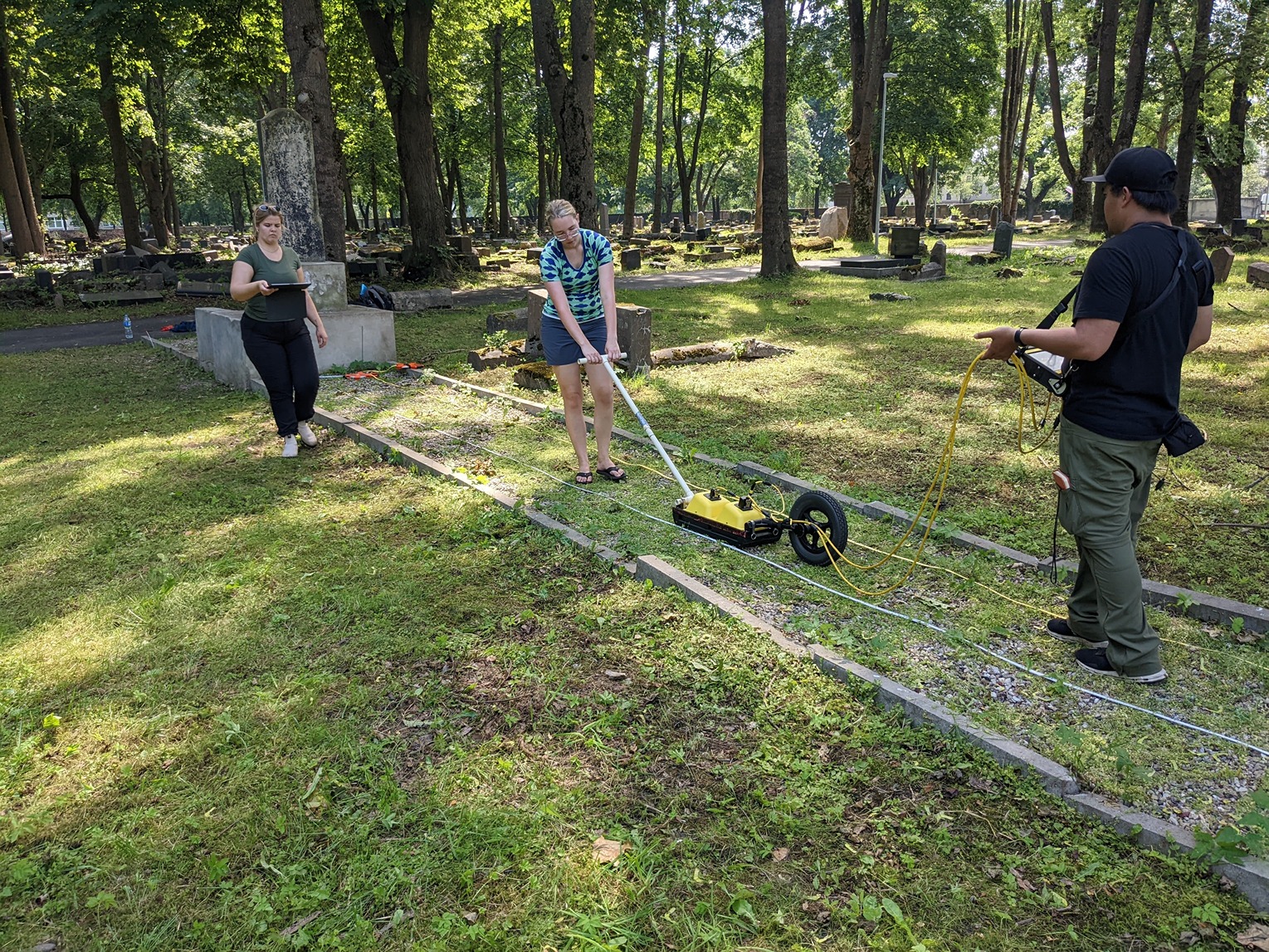
Photo: Dr. Harry Jol, professor of geography, and a team of research students are featured in a National Geographic documentary that highlights the team’s use of ground-penetrating radar to locate mass graves of the Holocaust at sites across Eastern Europe.
Dr. Harry Jol, professor of geography, and a team of research students are featured in a National Geographic documentary that highlights the team’s use of ground-penetrating radar to locate mass graves of the Holocaust at sites across Eastern Europe.

Students at the University of Wisconsin-Eau Claire have rare and unique research opportunities. We discover examples of this every semester. From therapeutic gloves for Parkinson’s disease patients to building a robotic dog or tracking the changing landscape in a Minnesota flood plain, Blugolds do it all.

But this is a first: Dr. Harry Jol, professor of geography, and a team of research students are featured in a National Geographic documentary that highlights the team’s use of ground-penetrating radar to locate mass graves of the Holocaust at sites across Eastern Europe.

Streaming on the National Geographic channel since mid-September, “The Hidden Holocaust” features several scenes and interviews depicting Jol’s ongoing research project called The Holocaust Mapping Program, work he and students have been conducting for more than seven years in places like Latvia, Lithuania and Poland, along with other locations in the former Soviet Union.

Jol’s ongoing research has been funded through the International Fellows Program at UW-Eau Claire, the L.E. Phillips Family Foundation and University Foundation donor Jeff Liddicoat. Jol’s work also has been supported by numerous in-country partners, such as the Jews in Latvia Museum and the Uniting Foundation of Latvia.

“This National Geographic documentary is actually drawn from a different documentary by the BBC, called ‘How the Holocaust Began,’” Jol explains.

This earlier film includes the team working in additional sites and with a strong focus on the tragic story from Alytus, Lithuania, where a suspected 8,000 people were executed in mass burial pits in the woods outside the town.

“None of the sites we work on are ever excavated, but the radar imagery allows for estimates of death tolls,” Jol says. “The story that eventually unfolded is truly unimaginable.”

The specific footage featuring the UW-Eau Claire team in the National Geographic and BBC films was shot in 2022, and the American research team that summer included:

  • Dr. Harry Jol, professor of geography at UW-Eau Claire.
  • Joe Beck, graduate of UW-Eau Claire with a degree in comprehensive environmental geography.
  • Delia Ihinger, graduate of UW-Eau Claire with a degree in geography.
  • Taylor Phillips, graduate of UW-Eau Claire with a degree in geospatial analysis and technology.
  • Tristan Wirkus, graduate of UW-Eau Claire with a degree in geospatial analysis and technology.
  • Michael Barrow, graduate of UW-Eau Claire with a degree in environmental geography.
  • Isabel Radtke, graduate of UW-Eau Claire with a degree in special education and inclusive practices.
  • Bri Jol, graduate of Gustavus Adolphus College with a degree in biology/environmental studies.
  • Dr. Phil Reeder, dean of environmental science at Duquesne University.
  • Caroline Hayes, mathematics major with minors in computer science, leadership and Judeo-Christian studies at Christopher Newport University.
  • Mikaela Martinez Dettinger, graduate of Christopher Newport University with a degree in political science and philosophy with a concentration in religious studies, and graduate student in Jewish studies at Indiana University.
The impact on undergraduates from research experiences like Jol’s ongoing projects is impossible to overstate — these are simply life-changing experiences on an academic, pre-professional and personal level. Dr. Erica Benson, executive director of UW-Eau Claire’s Office of Research and Sponsored Programs, has witnessed the growth of these students directly in the grant reviewing process.

“The work in Central and Eastern Europe that Dr. Jol engages UWEC undergraduates in not only has deep historical significance but also is incredibly meaningful for all involved,” Benson says.

“For several years, the Office of Research and Sponsored Programs has provided support to students working with Dr. Jol, both during the summer while they are in the field and during the academic year when they are analyzing and writing up their findings. Three things stand out about the students that work with Dr. Jol: the amount of work they put into writing their grant proposals, the amount of time and effort they devote to their projects and the variety of majors the students have. It’s rewarding to be able to support this work.”

Impact on former student researchers

For former student researcher Tristan Wirkus, seeing the research and the discoveries make their way to such an accessible platform as National Geographic is exciting and gratifying.

“This and other documentaries are taking the hard facts we learned through the research and launching it out into the world,” Wirkus says. “While it may be unpleasant to learn the details, people must recognize that the Holocaust wasn’t just in the concentration camps as part of the ‘Final Solution.’ Knowing how it really started in these hidden pockets of Europe is invaluable in a world where tensions can rise and history must never repeat itself.”

Wirkus graduated in May 2025 and now works for the land records division of Sawyer County in Hayward.

Another former researcher on the 2022 summer team is Delia Ihinger, a May 2024 graduate now working for the city of Blaine, Minnesota, in their geographic information system department. She, too, is very glad to see this important history disseminated by National Geographic and the BBC, outlets with a much more popular reach than academia and traditional research publications.

“That’s why this project, and others like it, are so important. These stories deserve to be found and told, these people deserve the respect that they did not get in their deaths,” Ihinger says.

“It’s gratifying to know that our work is able to reach more people through this documentary release and that the project continues into the future. Being part of this project was not what you would call a ‘normal’ college experience, but I’m so glad I got to be part of something so big, something that truly matters. It really was a huge part of my college career.”

Jol and a team of students will return next year to Eastern Europe, where sadly, there are more Holocaust discoveries to be made.


Written by UW-Eau Claire

Link to original story: https://www.uwec.edu/stories/uw-eau-claire-research-team-featured-national-geographic-and-bbc-documentaries

Share this

Recents
  • Community Capital: How Credit Unions and Universities Partner to Strengthen Wisconsin January 26, 2026
  • UW-Stout students collaborate across degrees in community project for The Neighbors January 21, 2026
  • UW-Oshkosh partners on $500K grant to reduce barriers to student success in Oshkosh schools January 20, 2026
Recents
Yearly
  • 2026
  • 2025
  • 2024
  • 2023
  • 2022
  • 2021
  • 2020
  • 2019
  • 2018
  • 2017
  • 2016
  • 2015
  • 2014
  • 2013
  • 2012
Monthly
  • January 2026
  • December 2025
  • November 2025
  • October 2025
  • September 2025
  • August 2025
  • July 2025
  • June 2025
  • May 2025
  • April 2025
  • March 2025
  • February 2025
  • January 2025
  • December 2024
  • November 2024
  • October 2024
  • September 2024
  • August 2024
  • July 2024
  • June 2024
  • May 2024
  • April 2024
  • March 2024
  • February 2024
  • January 2024
  • December 2023
  • November 2023
  • October 2023
  • September 2023
  • August 2023
  • July 2023
  • June 2023
  • May 2023
  • April 2023
  • March 2023
  • February 2023
  • January 2023
  • December 2022
  • November 2022
  • October 2022
  • September 2022
  • August 2022
  • July 2022
  • June 2022
  • May 2022
  • April 2022
  • March 2022
  • February 2022
  • January 2022
  • December 2021
  • November 2021
  • October 2021
  • September 2021
  • August 2021
  • July 2021
  • June 2021
  • May 2021
  • April 2021
  • March 2021
  • February 2021
  • January 2021
  • December 2020
  • November 2020
  • October 2020
  • September 2020
  • August 2020
  • July 2020
  • June 2020
  • May 2020
  • April 2020
  • March 2020
  • February 2020
  • January 2020
  • December 2019
  • November 2019
  • October 2019
  • September 2019
  • August 2019
  • July 2019
  • June 2019
  • May 2019
  • April 2019
  • March 2019
  • February 2019
  • January 2019
  • December 2018
  • November 2018
  • October 2018
  • September 2018
  • August 2018
  • July 2018
  • June 2018
  • May 2018
  • April 2018
  • March 2018
  • February 2018
  • January 2018
  • December 2017
  • November 2017
  • October 2017
  • September 2017
  • August 2017
  • July 2017
  • June 2017
  • May 2017
  • April 2017
  • March 2017
  • February 2017
  • January 2017
  • December 2016
  • November 2016
  • October 2016
  • September 2016
  • August 2016
  • July 2016
  • June 2016
  • May 2016
  • April 2016
  • March 2016
  • February 2016
  • January 2016
  • December 2015
  • November 2015
  • October 2015
  • September 2015
  • August 2015
  • July 2015
  • June 2015
  • May 2015
  • April 2015
  • March 2015
  • February 2015
  • January 2015
  • December 2014
  • November 2014
  • October 2014
  • September 2014
  • July 2014
  • June 2014
  • May 2014
  • April 2014
  • March 2014
  • January 2014
  • December 2013
  • November 2013
  • October 2013
  • September 2013
  • August 2013
  • July 2013
  • June 2013
  • May 2013
  • April 2013
  • March 2013
  • February 2013
  • January 2013
  • December 2012
  • November 2012
  • October 2012
Universities
  • Freshwater Collaborative of Wisconsin
  • Universities of Wisconsin
  • UW Colleges
  • UW Extended Campus
  • UW-Eau Claire
  • UW-Extension
  • UW-Green Bay
  • UW-La Crosse
  • UW-Madison
  • UW-Milwaukee
  • UW-Oshkosh
  • UW-Parkside
  • UW-Platteville
  • UW-Platteville; UW-La Crosse
  • UW-River Falls
  • UW-Stevens Point
  • UW-Stout
  • UW-Superior
  • UW-Whitewater
Categories
  • Community
  • Economic Development
  • Research & Innovation

Related Articles

  • Photo of UW-Platteville students collecting stream monitoring data.

    Farming is a vital part of Wisconsin’s economy, and agricultural practices significantly impact the state’s water resources. The Ag-Water Nexus Seminar and Ag-Water Nexus Field Experience equip students with a broad, interdisciplinary education that integrates agricultural and environmental perspectives. The courses rotate among four universities, allowing students to explore different agricultural areas in Wisconsin. The…

    January 16, 2026

    UW-Platteville spring course explores the connection between agriculture and water in Wisconsin

  • Photo of junior Finn Patenaude, a geography major with GIS concentration, presenting maps on optimal sites for wildlife crossings and the mass migration of monarch butterflies during UWL’s Geography & Environmental Science Department reverse career fair where students shared their projects with employers.

    Making a map isn’t just about marking locations on the Earth — it’s about uncovering the stories behind data and patterns that can ultimately help communities make informed decisions. This semester, UWL geography and environmental science students did exactly that. Through their Geographic Information Systems (GIS) coursework, they created maps that tackle real-world issues ranging from wildlife…

    January 15, 2026

    Mapping what matters: UWL students explore commerce, data center suitability, wildlife protection and other real-world questions through GIS

  • Photo: Sophomore biology major Andrew Smerz, right, enrolled in History Professor Gita Pai’s chocolate-themed history course for his love of chocolate. But he soon learned chocolate’s story stretches far beyond flavor, linking La Crosse to a much larger global history.

    When you think of chocolate, what comes to mind?  A creamy bite of a Hershey bar? A decadent layered dessert? Perhaps the whimsical world of Willy Wonka?  Those are the kinds of responses History Professor Gita Pai hears on the first day of her World History 110 course — a class built entirely around the history of chocolate. It’s a course…

    January 8, 2026

    Unwrapping chocolate: Students explore the complex, global history of chocolate from Mesoamerica to today

Universities of Wisconsin
Office of Public Affairs, Communications, and Branding
Madison, WI 53706

universityrelations@wisconsin.edu

  • Employee Intranet

© 2026 Board of Regents - University of Wisconsin System. All Rights Reserved

  • Accessibility Statement
  • Privacy Policy